


In 1845, Mass was regularly celebrated in the homes of Mr. John Farrell in Greenport and Mr. John Connally of Arshamomaque. These gatherings marked the beginnings of what would become St. Agnes Parish in Greenport. Priests traveled from Brooklyn for the next decade to minister to the faithful on the East End.
Father Joseph Brunemann became the first resident priest on the East End, living in Sag Harbor in 1859. As early as 1855, Bishop Loughlin purchased property in Greenport for a church, and a structure was erected; however, no formal parish was established for more than thirty years. While Father John McCarthy is recorded as the first resident priest in Greenport (1857–1859), it was Father Brunemann who gave the church its present name, St. Agnes. At that time, Mass was celebrated there only once every three months.
In 1868, Father John McKenna compiled the first list of adult Catholics on the North Fork’s East End, totaling 72 individuals. By 1870, the number had grown to 84. Father McKenna is also believed to have built the original St. Agnes Hall.
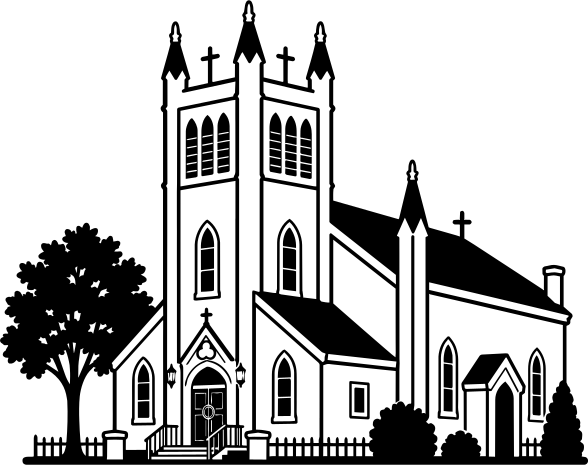
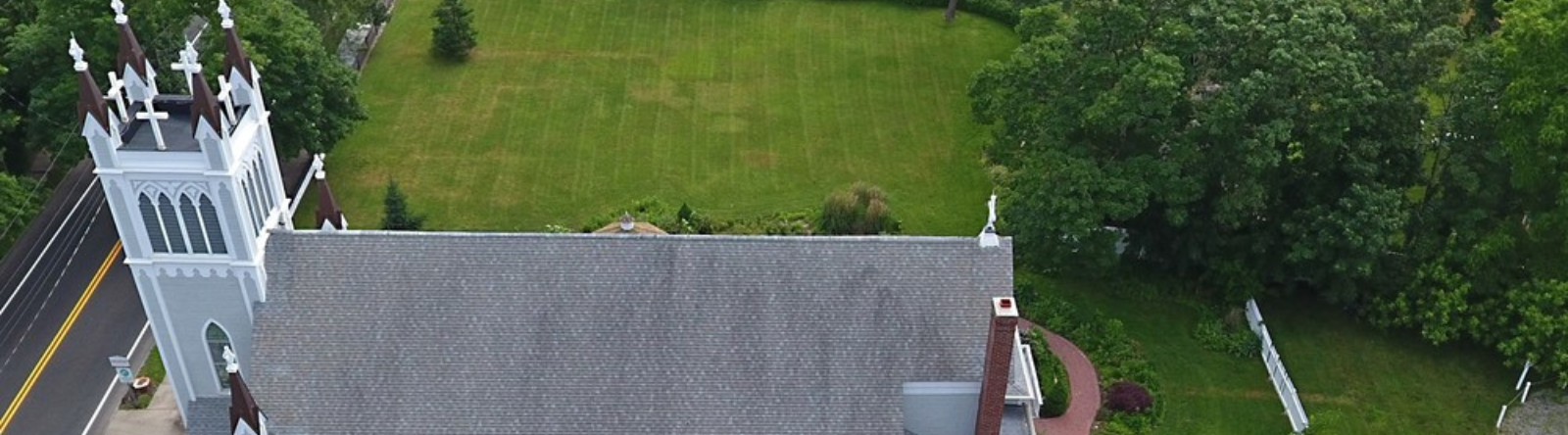
On September 28, 1884, the present St. Agnes Church, constructed under the direction of Father Richard Foley, was dedicated by Bishop John Loughlin. Two years later, in 1886, Father Mortimer Brennan became the first resident pastor, and in 1888 he took up residence in the current rectory.
On August 28, 1898, Father Patrick Farrelly purchased twelve acres along Sterling Creek, now the site of St. Agnes Cemetery. Although he later served as pastor of St. Brigid’s Church in Brooklyn and died in 1914, he is buried in St. Agnes Cemetery beneath a Celtic cross.
The church’s first major renovation took place in 1905 under Father Charles Gibney. He added the bell tower, installed new pews and an organ, and introduced the Stations of the Cross. He also added windows to the choir loft, renovated the parish hall, installed an iron fence around the property, and placed a Crucifixion scene above the altar, which has since been removed.
Throughout the years of the Great Depression and the World Wars, St. Agnes Parish was guided by many devoted pastors. In 1945, Father Edward Kelly was appointed pastor. On September 8, 1946, he dedicated an outdoor shrine to Our Lady in memory of parishioners who had died in both World Wars. The shrine was erected by Catholic War Veterans.
Father Jerome Holland became pastor in 1950 and oversaw significant improvements. He carried out interior renovations, expanded the rectory to accommodate an assistant priest, constructed a new parish hall, and added parking. In 1953, the parish purchased the Golden family home for use as a convent and welcomed the Sisters of Mercy.
In 1954, Father James Mooney succeeded Father Holland and initiated plans for St. Agnes School. This vision was realized on September 18, 1960, under the leadership of Father Joseph Tennant. In 1969, Father Virgil Power became pastor, and the parish celebrated its 100th anniversary with another church renovation, including paneling the sanctuary in keeping with the style of the time. In June 1971, the parish celebrated the ordination of Father Ray Walden, the first parishioner of St. Agnes to be ordained.
St. Agnes continued to flourish under Father Rocco Gallitelli. In 1987, Father John Sullivan became pastor and oversaw significant interior updates, including expanding the altar, recessing the ceiling lights, and installing a sound system. His successor, Monsignor Charles Guarino, further improved the sound system and relocated the baptismal font to the front of the church.
In 2002, Father Tom Murray was appointed pastor and served until June 2014, when Father Richard Hoerning succeeded him. After six years of service, Father Hoerning retired in August 2020, and Father Piotr Narkiewicz was appointed administrator. He served until August 2025, when Father Mike Bartholomew became the current pastor of St. Agnes.
Today, more than 750 families are registered at St. Agnes Parish, and the community continues to grow. While the church’s interior has evolved over time, the faith and devotion of its people remain a constant and enduring tribute to its rich history.